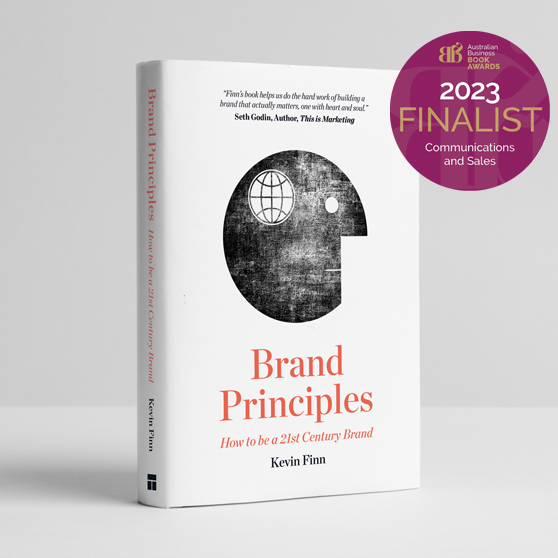
Not every business is a brand. In fact, most businesses aren’t. And that’s okay. But what if you could implement the approach, attitude, and mindset that makes successful brands so successful? How valuable would this be to your business?
While branding agencies, brand architects, brand consultants, brand designers, design thinkers, or any number of brand ‘experts’ might suggest (with enthusiasm) that they can create or build your brand for you it’s important to understand this claim is not only disingenuous—it’s dangerous.
The truth is they are in no position to build a brand on your behalf. Believing them is the first step in misunderstanding how a brand is developed and what a brand actually is. Of course, there may be exceptions but, for the majority of cases the brand must come from you. And it’s not an easy, quick or passive exercise. Nor is it something you can simply outsource. If you are serious about developing your brand, most of the longterm, heavy lifting and ongoing work required to build your brand must be done by you—and your entire staff. Never forget: your brand is your business. You are an active participant.
So what’s the difference between a brand and branding?
A brand is who you are. It is the core value of your business offer and a promise to your customers of the value they should expect. It is the sum of all the experiences someone has with your business. It is what you live and deliver every day. It cannot be manufactured, created or invented by an external consultant (because then you’ll be required to live up to someone else’s vision, rather than your own).
Branding is how you articulate and appropriately communicate your brand—to your customers, and to the world. This is where designers are useful.
15 Brand Principles
Great businesses rarely just happen; they are designed—deliberately. No matter what business you are in, every staff member contributes to how you build your brand, how it is experienced and how it is championed; from administration through to finance, product development and customer service—everyone contributes to the brand.
More than that, great brands are conscious and intentional about their core focus and how they are perceived, so it’s worth considering the following general principles, whether you’re a start-up or an established business.
1. Branding is the most valuable real estate in the world—a corner of someone’s mind (1), whether they are your core customer, or not.
2. All successful branding is based in a truth—it’s also the easiest way to implement and maintain your communications because truth is natural, memorable and genuine. It’s also expected.
3. Branding is internal before it’s external—your staff need to be your greatest ambassadors. The mistake is to think branding is only about broadcasting externally.
4. Branding is not a department—it’s the responsibility (and representation) of your entire organisation, from receptionist to CEO.
5. Branding is cultural—it’s the collective attitudes and ideas of a group of people. Your brand is as much about individual behaviour as it is about collective behaviour.
6. Mission, Vision and Values are internal—these are a great internal guide but no one outside the organisation really cares. They will only be interested in the value you provide them.
7. Your brand is not just what you say it is—it’s what other people say it is; the challenge is managing the gap. And never underestimate the power of perception because it can be more persuasive than the truth.
8. Your brand is not your logo—your logo is the shorthand visual reminder; your brand is the relationship you have with your customer. Brand is who you are and how you act, identity is how you look (2). And everything you do is communication.
9. Branding makes an organisation visible and understood—the logo and communications material are a window to your brand. Consider how you want to be seen. If you’re not clear about your own brand, don’t expect that others will be, either.
10. Your brand is your filter—use it to help decide on everything, from hiring staff to making acquisitions or pursuing initiatives. It’s all about finding the right fit.
11. Don’t just have a positioning—have a position. Taking a stand will help define the brand purpose.
12. A brand is a long-term and evolving objective—it requires dedication and commitment. Building and maintaining your brand cannot be outsourced. It’s not a short-term exercise.
13. More than ever, your customer or end user is at the heart of your brand—whether you like it or not. Put simply: Your brand is the promise you make; the customer experience is the promise you keep. (3)
14. If your brand is to have value, what you do must have value—branding is the articulation of that value.
15. It helps if you can explain your brand purpose in a few words—for example: one word equity, single-minded proposition, unique selling proposition. This makes it easier for staff and customers to remember your brand purpose.
——————————————
(1) Hegarty On Advertising (Thames & Hudson), Sir John Hegarty, page 39.
(2) Ian Anderson, The Designers Republic, UK.
(3) Proto Partners, website (Company / What We Believe)